Robots and Cats

If you write, you find yourself circling the same subjects over and over again. Many of my stories center on the complex issues of motherhood, and the relationship between mothers and daughters (Spectrum of Acceptance and “Mothers Know Buttons”). I also tend to write about feeling out of place and not understanding the social rules (Spectrum of Acceptance and “The Kio Empress”). It doesn’t take therapy (though I’ve paid a lot of money to therapists in my lifetime) to see where these repeating ideas come from. I have a complicated relationship with my mother (a brilliant and beautiful person whose own relationship with motherhood is complicated). Like many women in the United States, the pressures of being a “good mom” and the cost of being a “good mom” are at war in my life, doubly so because I have a 2E child (he has a disability and he’s smarter than average). And, my entire family, myself included, is an entire spectrum of socially awkward. My social anxiety is only enhanced by policing the behavior of my husband and son.


The latest stories, though, are mostly about growing old and having your child grow up and leave. That 2E kid I mentioned? He’s 17. Next year he will be a Senior in high school. We have started the prep work to transition him to university (fingers crossed) and an independent life (toes crossed, too). I can see all my anxiety about the next few years staining the pages I’m writing. The stories are filled with cishet couples whose children have moved out. They are dripping with robots trying to find their use when their primary user is gone. I’m guessing there are real reasons none of these stories feel done and ready to share even with my most enthusiastic and supportive alpha readers. I don’t have answers for the robots because I don’t have answers for myself yet.

Socks, the robotic cat, from Lightyear

In the stories I write, AIs and robots that emulate all kinds of things, dogs, people, actual mothers (and there is a Freudian slip–not classifying mothers as people), and appliances. But, weirdly never cats. No, when I write about cats they are cats. Maybe they have been altered to speak, but essentially, they are still the cats that have been semi-domesticated for over ten thousand years.
I’m not alone in this. Science fiction is packed with robotic dogs. It’s also packed with psychic cats and talking cats, and normal cats, but very rarely robotic cats. The Buzz Lightyear movie has a robotic cat and it stands out as the exception. I did a quick survey of children’s books about robot cats and turned up one and a large number of books about cats fighting robots. It’s not that we don’t like robotic cats. There are tons of robot toy cats for sale on Amazon. Perhaps it’s not by accident that all those robot cats are toys, that there is no useful robotic cat on the market. Don’t get me wrong, cats have been very useful in human societies. They kill small rodents and discourage the presence of larger rodents, like rats. And yet, we have robotic “dogs” being leased out to the New York City police but no robotic cats to take on the more pressing problem of city rats.
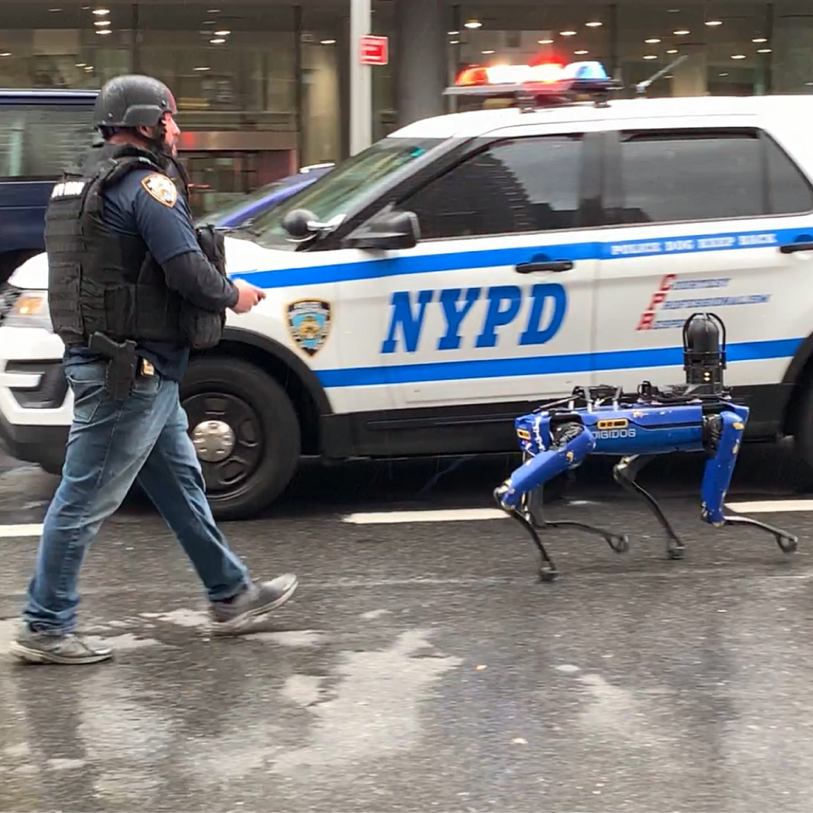
NYPD police officer with a robotic dog

Some studies show our brains store dog names with children’s names (which is why parents sometimes accidentally call their child by the dog’s name) and we don’t store cat names in the same location. So, I’m not alone in loving my cats but also holding them separate. There is something about cats, their independence and their dependency, that makes them special. I don’t think of them as being here to be of service to me but rather something for me to beg attention from. Humans and cats live as a covenant. They know we are larger and scarier, but they also know we offer food, protection, a warm place to sleep, and pleasing pets. The real trick of that relationship, though, is how we humans crave the intermittent reinforcement of their affection. We are their Pavlovian dogs, fingers twitching to sink into their soft warm fur.
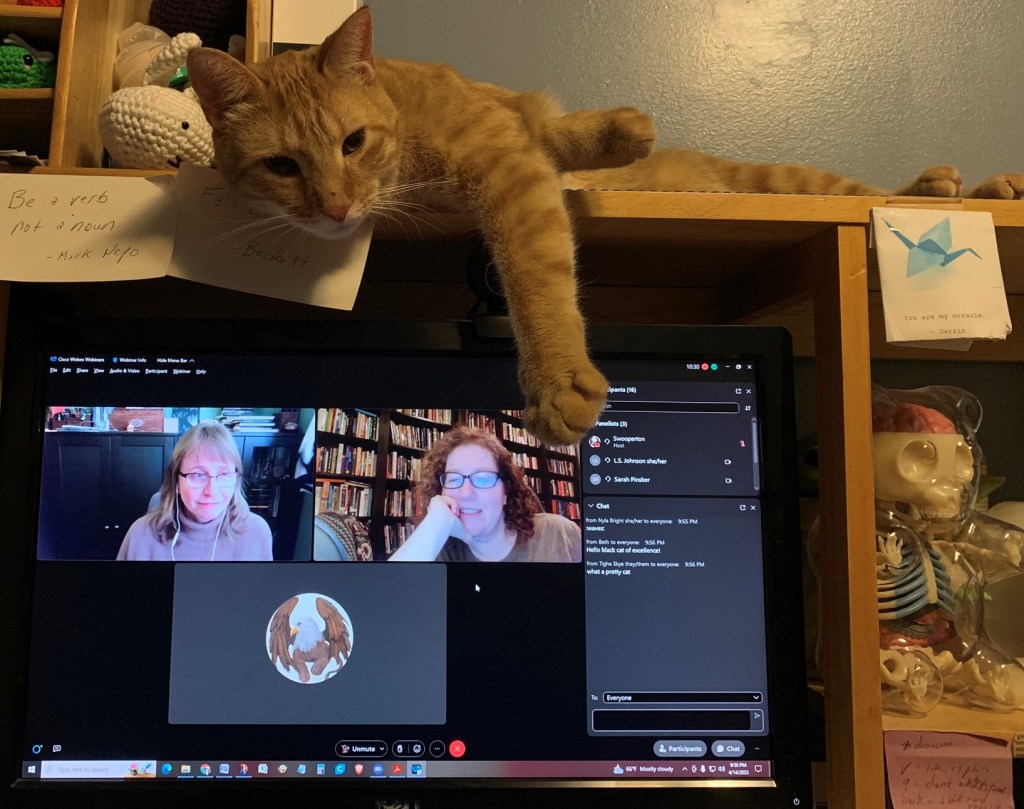
My cat, Loki, interrupting an online convention (Sarah Pinkser and L.S. Johnson at Flight of Foundry)


Easy or Hard. It’s complicated

Nothing annoys my half-sister, Teresa, more than someone, on hearing she majored in math at Cornell, saying, “Oh, math must be easy for you.” Math, she often points out, is hard. No matter how far you get in math, it is always work. At the time I agreed with her. Of course, math is hard work. I had, after all, nearly failed Algebra II and only passed because the school district agreed to let my mother hire a private teacher to teach me one-on-one. And that near failure, the expense of the private teacher, and my complete inability to get anywhere in math must be because I didn’t work hard enough.


But… Math is easier for Teresa than for me. Not because I’m lazy (though some of those lazy behaviors formed in direct response to a lifetime of failure) but because I have ADD (the old designation they used to give to ADHD kids who had the inattentive type). My working short-term memory is fairly shallow. Rattle a string of numbers off at me and I am lucky to remember 4 of them. I can’t retain more than two steps in driving directions, either. Doing math with a poor working short-term memory is like trying to tie shoelaces one-handed. I’m lacking a basic ability most people take for granted for doing math quickly and accurately. The other day I accidentally miscalculated and moved $1000 more into my checking account to pay a bill than was needed. I have no idea where I did the math wrong, but the cash flow prediction on my money management software made it clear I had made an error (which is why I use the cash flow prediction–all is fine if I move $1000 too much into the checking account but a disaster would have landed if I had $1000 too little).

It came as a shock to me that I scored better than average on my math portion of the SAT. Given all the Cs, Ds, and narrowly avoided Fs, I expected the math portion of the SAT to be bad. It wasn’t. I scored above average. Not good enough for a school like Cornell but comfortably high enough that I had my pick of most colleges. But, I still solidly believed myself bad at math and it remained a mystery to me why I scored so well. I avoided math as an undergraduate, opting to take “Math for the Liberal Arts Major” which was algebra again coupled with reading Flatland. I majored in English; avoiding math wasn’t hard. However, graduate school was another story. I had to take statistics for my MSM-IS degree. There, though, I lucked out. I had a professor who felt that doing equations by hand was a waste of time. We did all our homework in Excel. I went into the first test terrified about what a disaster it was going to be. The folks with undergraduate majors in engineering strutted in confidently. It turned out I didn’t need to worry. The test wasn’t doing the formulas, but instead predicting if one variable in the formula changed, and how that would affect the result. Analytic skills and just grokking a model landed right in my strongest skill set. I outscored several of the engineering students on the test because they could use the formulas and do the math, but didn’t understand the relationship of the variables. This started to change my understanding of what it meant to be bad at math. Are you bad at math if you aren’t a human calculator? Are you good at math if you understand that when the velocity of money increases, so does inflation if the amount of money in the system and the supply of goods remain constant?

In theory, barring significant medical limitations, most people are capable of training for and running a marathon. No one looks at a marathon runner and says, “26.21 miles of running must be easy for you.” But, the truth is, no matter how long or hard I train, I’m never going to run the Boston Marathon. Maybe I could, with a massive commitment of time, training, diet, and the help of a lot of professionals, get to the point of running a marathon, but I’m never ever going to make that run in under 3 hours 55 minutes (the qualifying time to apply to run the Boston marathon for women in my age group). So, yes, running is easier for a marathon runner.

So, what is my point here? I guess it’s that something can be easy AND hard at the same time. I ride an eBike. Some people say I’m cheating because my bike has pedal assist. The kind of people who make those comments always weigh a great deal less than I do. I know that if I loaded them up with weights to match my mass, those fit, strong riders would have a hard time getting started, let alone going a mile. Inertia is a bitch. The eBike is an accommodation for gravity, which affects me more profoundly than it does them. They don’t see their privilege. Yes, they work hard. I pedal hard, too. But, on a hill, where they are feeling the full force of gravity? The privilege of pedal assist is undeniable.

Is math easier for my half-sister than for me? Yes! Is majoring in math easy? No! Am I “bad” at math because I have a janky short-term working memory–well, kind of but also no. It’s complicated. I don’t have to be bad at math because we live in a world where there are all kinds of tools that make up for my shortcomings and lean into my strengths. My mother saved an entire month’s salary to buy her first calculator, which could only do addition, subtraction, division, and multiplication. These days I carry a mini computer in my pocket which can do calculations that required a fairly beefy laptop 20 years ago. It’s ok to admit your privileges (a socioeconomic advantage, private math teacher, innovative and flexible statistic professor, having an iPhone), it doesn’t invalidate where you are disadvantaged.